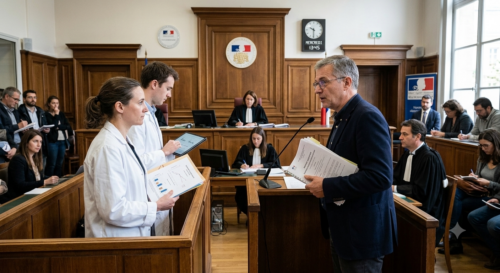
Paris, April 30, 2026 — Antidote Europe, an association founded by scientists, faced off against the European Commission (EC) before the General Court of the European Union (GCEU) on March 18, 2026, over the potential toxicity of glyphosate. The hearing lasted more than five and a half hours. The exchanges were substantive, and it was clear that the rapporteur judge had thoroughly examined some of the issues raised. *
In November 2023, the EC reauthorized this substance — the active ingredient in the herbicide Roundup, sold worldwide — for ten years. On November 19, 2025, environmental protection associations already partly won their case when the Court of Justice of the European Union (CJEU) ruled that the glyphosate reauthorization should only have been granted for one year, in accordance with the regulations.
For its part, Antidote Europe cited studies on glyphosate’s possible role as a human carcinogen. It challenges the use of data obtained from animal testing in assessing the risk posed by chemical products. To our knowledge, this is the first time the lack of justification for animal testing has been debated before a court. The association’s lawyer regrets that this point did not receive the attention it deserved during the hearing. Nevertheless, the question of how scientific expertise is used in approval processes remains. Did the European Commission actually review the scientific warnings submitted to it before confirming the ten-year reauthorization of glyphosate? *
While scientific expertise is supposed to be provided by the European Chemicals Agency (ECHA) or the European Food Safety Authority (EFSA), the EC was supported at this hearing by Bayer Agriculture B.V. — the manufacturer of glyphosate itself!
Bayer is reportedly preparing to bring a new herbicide, icafoline methyl, to market, currently under evaluation in Austria. Scientific warnings have already been raised about its possible effects on the human gut flora. According to information obtained by Antidote Europe from the French Agency for Food, Environmental and Occupational Health & Safety (ANSES), these warnings have not led to a definitive conclusion, due to the lack of a standardized evaluation procedure.
The question of how relevant, independent human health data is factored into the approval processes for substances sold by the chemical industry deserves to be better explained to the general public. Antidote Europe hopes that the ruling from the March 18 hearing, expected in the coming months, will help shed light on this.
Contact:
André Ménache, President of Antidote Europe, veterinarian
06 23 42 62 95
https://antidote-europe.eu
* Comment from Me Arnaud Durand (Lexprecia law firm), Antidote Europe’s lawyer, following the hearing.