After more than three years of work with a lawyer, we were heard before the General Court of the European Union in March 2026 regarding the possible toxicity of glyphosate. The manufacturer and the authorities rely on data obtained from animal testing; we are calling for human data to be taken into account.
For several years, Antidote Europe has been taking legal action with the help of lawyers. Highlighting the risks of relying on animal experimentation results for human health applications, no fewer than five cases, built on solid scientific arguments, are currently underway. On March 18, 2026, the first was presented and argued at a hearing before the General Court of the European Union (GCEU) by Me Arnaud Durand, a specialist in health-related issues.
We were up against none other than the European Commission (EC), supported by Bayer Agriculture B.V., regarding the ten-year reauthorization of glyphosate issued by the EC in November 2023.
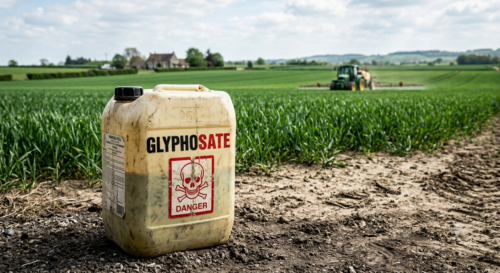
This chemical substance is the active ingredient in the herbicide Roundup, widely used around the world. Numerous scientific and legal battles have raged, and continue to rage, over its possible toxic effects on human health.
Using reliable data
As the subject is very broad, we focused on studies concerning possible carcinogenic effects. We are calling for reliable, independent human data to be taken into account, whereas regulatory authorities also accept results from animal testing.
As early as 2023, we contacted a law firm already working with several associations, particularly environmental ones. Various legal avenues were considered. As a first step, together with other associations, we filed a “request for internal review” of the regulation reauthorizing glyphosate. This request, sent directly to the EC in January 2024, was rejected the following summer.
Yet our case was solid, particularly thanks to data published in recent years. Was the EC aware of this data? On our lawyer’s advice, and of course with his assistance, we filed an appeal with the GCEU in September 2024.
Acting together
At the same time, other associations, including Pollinis (France) and a German association, turned to the Court of Justice of the European Union (CJEU) and, on November 19, 2025 — a very encouraging development for us — received a partly favorable ruling: the EC should not have reauthorized glyphosate for ten years, but only for one year. It was found to have made an “error of law.”
In early December 2025, we received good news: our appeal would be examined by the GCEU on March 18, 2026. We were there! As was the Collective of Anti-Pesticide Mayors.
An attentive court
The hearing followed numerous written exchanges between the Court and the two parties involved. The arguments were therefore known in advance, and ours — based on the precautionary principle and the lack of justification for animal testing — were far from negligible.
“The hearing lasted more than five and a half hours. The exchanges were substantive, and it was clear that the rapporteur judge had thoroughly examined some of the issues raised,” commented Me Durand at the close
of the hearing.
As for the lack of justification for animal testing, this is, to our knowledge, the first time it has been debated before a court! Me Durand regrets that it did not receive the attention it deserved. Nevertheless, the question of how scientific expertise is used in approval processes raises concerns for our lawyer: “Did the European Commission actually review the scientific warnings submitted to it before confirming the ten-year reauthorization of glyphosate?” In conclusion, “the Court pushed the EC into a corner on several points.”
Antidote Europe succeeded in being heard before a court as a scientific expert. The judge’s ruling, expected in a few months, cannot take anything away from this success.
A successor for glyphosate?
On December 13, 2025, we wrote to ANSES (the French Agency for Food, Environmental and Occupational Health & Safety). On the one hand, recent scientific studies suggest a possible harmful effect of glyphosate on the gut microbiota, whose role in maintaining good health (immunity, metabolism, etc.) is increasingly well established. On the other hand, Bayer is proposing a new product, icafoline methyl, as a possible replacement for glyphosate. We asked ANSES whether studies on glyphosate’s impact on the gut microbiota are indeed being taken into account, and whether Bayer will be asked to conduct in vitro tests to demonstrate the safety of icafoline methyl for the human gut microbiota.
On March 26, 2026, we received a response. Regarding glyphosate’s possible effects on the microbiota, ANSES informed us that studies published in the scientific literature had been taken into account by the regulatory authorities… but that “no definitive conclusion resulted from this literature review”! Once again, we observe that regulatory requirements lag several years behind scientific knowledge. During those years, we are therefore exposed to poorly assessed risks.
Regarding icafoline methyl, ANSES informed us that the substance is currently under review and that a public consultation is open. We are considering possible follow-up action.
As part of this campaign, we issued a press release. We hope to have further contact with the media once the Court has issued its ruling.